
In recent years, interest in apheresis has been growing among people traveling internationally for advanced medical care.
Often described as “blood purification,” “plasma exchange,” or “blood cleansing,” apheresis is actually a broad group of medical technologies designed to separate blood components and selectively remove or modify specific substances in the blood.
These may include antibodies, immune complexes, lipoproteins, inflammatory mediators, and other plasma components, depending on the specific technique and medical objective.
Apheresis is already an established therapeutic field for a range of conditions, including certain autoimmune and neurological disorders and severe lipid disorders. At the same time, researchers are increasingly investigating whether manipulating the plasma environment may have broader implications for inflammation, aging, and longevity.
However, one point is essential to understand:
Not all apheresis treatments are the same.
The value of apheresis lies not simply in removing substances from the blood, but in determining what should be removed, why it should be removed, and which technology is most appropriate for the individual.
Apheresis Is Not Simply About “Removing Bad Things”
The human bloodstream contains an extraordinarily complex mixture of proteins, lipids, antibodies, hormones, electrolytes, and other biological molecules.
It would therefore be an oversimplification to think of blood purification as simply removing as many unwanted substances as possible.
Some substances that may appear undesirable in one context are essential for normal physiological function.
For this reason, modern apheresis focuses increasingly on selectivity.
One established approach is therapeutic plasma exchange (TPE), in which plasma is separated from blood cells and replaced with a replacement fluid. This can reduce a broad range of circulating substances, including pathogenic antibodies and immune complexes.
Another approach is double-filtration plasmapheresis (DFPP).
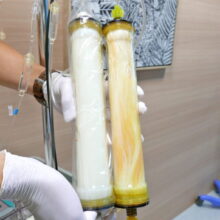
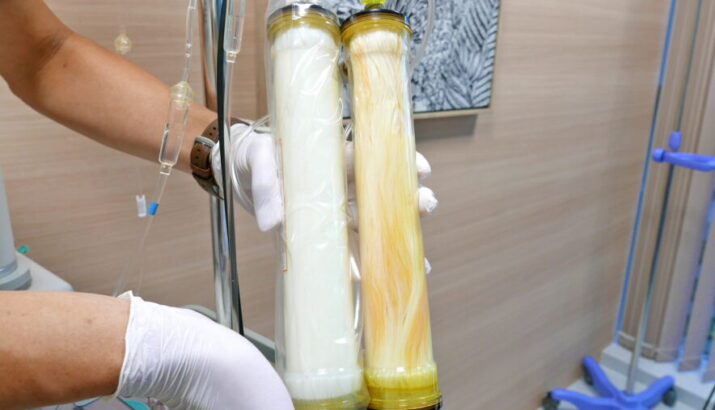
In DFPP, plasma is separated from blood cells and then passed through a second filter designed to selectively retain larger molecular components while allowing smaller molecules to pass through. This approach can reduce certain high-molecular-weight substances while retaining a greater proportion of smaller plasma proteins.
Other techniques include immunoadsorption, in which specific antibodies or immunoglobulins are selectively removed using adsorption columns.
Lipoprotein apheresis is another specialized approach designed to reduce atherogenic lipoproteins, including LDL cholesterol and, depending on the system used, lipoprotein(a).
The key point is therefore simple:
Apheresis is not one treatment. It is a family of technologies with different targets and different mechanisms.
Japan’s Development of Selective Blood Purification
Japan has developed considerable expertise in membrane-based blood purification technologies.
While centrifugal separation is widely used internationally, membrane separation has also played an important role in the development of Japanese apheresis medicine.
This technological background has contributed to the clinical use and development of selective plasma purification techniques such as DFPP.
The Japanese Society for Apheresis has published clinical guidance covering a wide range of apheresis techniques and indications.
This is particularly relevant for international patients considering treatment in Japan.
Rather than simply looking for a facility that offers “apheresis,” it is worth asking:
Which type of apheresis is being used, and why was that particular method selected?
The answer should be based on the patient’s medical condition, laboratory findings, treatment objectives, and overall risk profile.
From Disease Treatment to Longevity Research
Apheresis has traditionally been associated with the treatment of specific diseases.
However, interest in the technology has recently expanded into the fields of aging biology and longevity research.
One area of interest is the relationship between circulating plasma factors, chronic inflammation, cellular senescence, and systemic aging.
As people age, changes occur in the composition of circulating proteins and other biological molecules. Researchers are investigating whether some of these circulating factors contribute to chronic inflammation, tissue dysfunction, or age-related changes.
This has led to growing interest in whether modifying the plasma environment could influence biological markers associated with aging.
Several recent studies have explored therapeutic plasma exchange and related approaches in healthy or aging populations.
Some studies have reported changes in biological age markers following plasma exchange-based interventions. However, other studies have failed to reproduce similar findings or have reported different results depending on the biological clock or protocol used.
This is an important distinction.
The current evidence does not justify the simple claim that plasma exchange “reverses aging.”
Rather, the field is still investigating a much more interesting question:
Can specific components of the circulating plasma environment be modified in a way that influences biological processes associated with aging?
That question remains an active area of research.

Why Pre-Treatment Assessment Matters
For individuals considering apheresis, one of the most important factors is not the machine itself.
It is the medical assessment performed before treatment.
A comprehensive evaluation may include blood counts, liver and kidney function, coagulation parameters, lipid profiles, inflammatory markers, immune-related parameters, and other tests depending on the individual’s medical history and objectives.
The purpose is not simply to confirm that a person can undergo a procedure.
It is to determine whether apheresis is medically appropriate in the first place.
This distinction is particularly important in the longevity field, where patients may arrive with broad objectives such as “improving circulation,” “reducing inflammation,” or “optimizing health.”
A responsible medical approach should translate those broad objectives into measurable medical questions.
How to Evaluate an Apheresis Facility
For international patients, choosing an apheresis facility should involve more than comparing prices or equipment.
Several factors deserve consideration.
1. Is there a proper medical assessment before treatment?
Apheresis should not simply be treated as a standardized wellness procedure.
The patient’s medical history, medications, laboratory findings, and overall health status should be reviewed by an appropriately qualified physician.
The decision to undergo treatment should follow a medical assessment rather than precede it.
2. Does the facility have access to multiple approaches?
Because different apheresis technologies target different components of blood, a facility that can consider more than one approach may be able to provide a more individualized treatment strategy.
This does not mean that a facility must offer every available technology.
Rather, the important question is whether the treatment method is selected because it is appropriate for the patient, rather than because it happens to be the only method available.
3. Is there an experienced multidisciplinary team?
Apheresis involves extracorporeal circulation and requires careful management of vascular access, blood flow, anticoagulation, filtration systems, fluid balance, and the patient’s physiological condition during treatment.
For this reason, experienced physicians, nurses, and clinical engineers or other appropriately trained medical professionals can all play important roles in safe treatment.
The quality of the clinical team and its experience with extracorporeal therapies can therefore be just as important as the technology itself.
4. Are treatment results evaluated objectively?
Another important consideration is whether the patient’s condition is evaluated before and after treatment.
Instead of relying solely on subjective impressions such as “feeling better,” objective laboratory data can provide additional information.
Depending on the treatment objective, clinicians may evaluate changes in lipid profiles, immune-related markers, inflammatory parameters, or other relevant measurements.
The question should not simply be:
“Did we perform the treatment?”
It should also be:
“What changed, and what does that change mean?”
From Blood Purification to Blood Profiling
The future of apheresis may ultimately depend as much on advanced diagnostics as on the purification technology itself.
Modern proteomics allows researchers to analyze large numbers of proteins circulating in plasma.
Large-scale studies are now exploring whether plasma protein patterns can provide information about biological aging, organ-specific aging, and future disease risk.
This opens the door to a potentially different model of blood purification:
Testing → Medical assessment → Targeted intervention → Re-testing → Long-term monitoring
Instead of applying the same procedure to everyone, future approaches may increasingly consider the individual’s unique biological profile.
For example, one person may have a particular lipid-related risk profile, while another may show different immune or inflammatory characteristics.
The goal would not necessarily be to “clean the blood,” but rather to understand the biological environment of the blood and determine whether there is a medically meaningful reason to modify it.
Why This Matters for International Patients
International patients face additional challenges when seeking advanced medical care abroad.
Medical records may be incomplete or presented in different formats. Medication histories need to be accurately communicated. Laboratory reference ranges may differ between countries. Language can also become a barrier when discussing complex medical procedures.
For these reasons, the quality of the patient journey extends beyond the procedure itself.
An appropriate international medical care process may include:
- Review of previous medical records
- Pre-treatment medical assessment
- Appropriate laboratory testing
- Physician-led treatment planning
- Coordination with specialists when necessary
- Professional support throughout the treatment
- Documentation of treatment and laboratory results
- Communication of relevant information for follow-up after returning home
For an international patient, the ability to coordinate these steps can be an important part of the overall medical experience.
Apheresis Is an Evolving Medical Technology
Apheresis should not be described simply as a “detox treatment” or a guaranteed anti-aging therapy.
Its established medical applications are already significant, while its potential applications in longevity and healthy aging remain an active area of scientific investigation.
That combination makes the field particularly interesting.
The most important questions are becoming increasingly sophisticated:
What should be removed?
Why should it be removed?
Which technology is most appropriate?
What changed after treatment?
And how should that information influence future medical decisions?
These questions represent a shift from the traditional concept of “blood cleansing” toward a more precise model of blood purification and biological assessment.
For anyone considering apheresis, the facility itself should therefore be evaluated not simply by whether it owns an advanced machine, but by the quality of its medical assessment, the expertise of its clinical team, the range of available technologies, and its ability to objectively evaluate outcomes.
The future of apheresis may not be about simply removing more substances from the blood.
It may be about understanding the blood in greater detail—and intervening only when there is a meaningful medical reason to do so.
From blood cleansing to precision blood management, apheresis is becoming part of a broader conversation about personalized medicine, preventive health, and the biology of aging.